


Marcus Tempus
Product Story
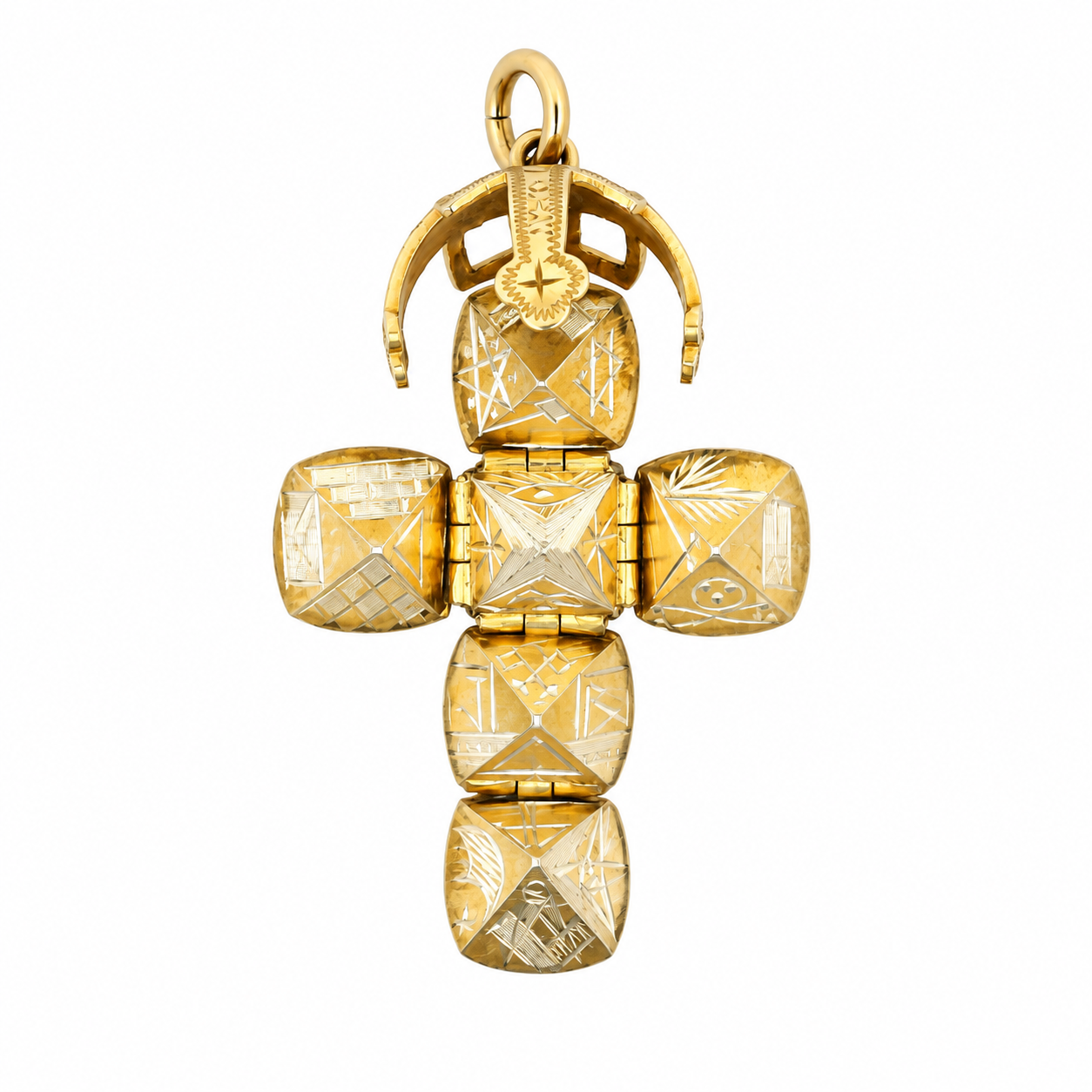
At first glance, this remarkable vintage piece appears to be a beautifully detailed 9ct yellow gold ball pendant. Release its ingenious hinged construction and the sphere unfolds completely, transforming into an elaborate Masonic cross.
Each articulated section of the cross is individually engraved with intricate Masonic symbols and geometric motifs, picked out with contrasting bright-cut detailing against the warm yellow gold. When folded back together, the cross disappears neatly inside itself, returning to its discreet spherical form.
Part jewellery, part miniature feat of engineering, this is exactly the sort of unusual antique and vintage piece we love finding for our One and Only collection.
Features
Material: 9ct Yellow Gold
Design: Transforming Masonic Ball & Cross
Mechanism: Hinged ball unfolds to form a cross
Detail: Individually engraved articulated panels
Collection: One and Only
Condition: Vintage – individual character and age-related detail expected
Availability: Available Now
One individual piece
Why We Love It
It has a secret. ❤️ Worn closed, nobody would suspect that the little gold ball contains an intricately engraved Masonic cross. Then it unfolds — and suddenly you have an entirely different piece of jewellery. The tiny hinges, engraving and clever construction make it fascinating from every angle. It’s not simply a pendant; it’s a miniature piece of mechanical craftsmanship.

Marcus Tempus Heritage Passport
Reference: MT-HP-002
Travel Through Time
Victorian Jewellery
Destination: Victorian Britain · 1837–1901
Jewellery shaped by sentiment, symbolism and extraordinary craftsmanship.
The Age of Sentiment
Jewellery With Meaning
Victorian jewellery was rarely chosen for appearance alone. A serpent could represent eternal love, a forget-me-not remembrance, and a locket might hold a portrait, a curl of hair or a private message.
Love, family, faith and memory were expressed through gemstones, motifs and hidden details intended to be understood by the wearer.
Britain, circa 1870
Lockets, engraved gold and symbolic motifs made jewellery intensely personal.Care & Preservation
Respecting Historic Construction
Victorian jewellery may contain foil-backed stones, closed settings, enamel, seed pearls or delicate hinges. Water, steam and ultrasonic cleaning can cause permanent damage to some pieces.
Cleaning and restoration should always be guided by the construction of the individual jewel rather than by the gemstone alone.
Details to Discover
Recognising Victorian Jewellery
Serpents and Symbols
Serpents, flowers, hearts, hands, anchors and celestial motifs carried meanings of love, faith and protection.
Lockets and Secrets
Portraits, hair and private inscriptions could be concealed inside jewellery worn close to the body.
Hand Engraving
Monograms, floral scrollwork and finely cut patterns gave even small jewels individual character.
Enamel and Colour
Black, blue, white and multicoloured enamel introduced contrast, symbolism and decorative richness.
Materials of the Era
Colour, Texture and Meaning
Warm and Expressive
Rich yellow gold suited engraved surfaces, sculptural motifs and lockets.
Diamond-Set Contrast
White silver settings allowed diamonds to shine while gold protected the reverse.
Decorative Storytelling
Enamel added colour to flowers, memorial jewels and ceremonial pieces.
Pinchbeck and Rolled Gold
Period alternatives were also used and should be identified honestly.
Gemstones of the Era
A Rich Victorian Palette
Garnet
Deep red garnets brought warmth and romance to rings, brooches and necklaces.
Turquoise
Turquoise appeared in sentimental clusters and floral designs.
Opal
Opals offered changing colour and mystery, particularly in later Victorian jewellery.
Pearl
Seed pearls and natural pearls appeared in delicate floral, memorial and bridal jewels.
Did You Know?
Victorian Jewellery Changed With the Queen’s Life
Marcus Tempus Heritage Jewellery
A Piece With a Past
Individual Character
Antique jewellery may show gentle wear, historic repairs, earlier resizing or replaced components.
Professionally Examined
We examine the setting, gemstones, hinges, clasps and principal components before offering a Victorian piece for sale.
i
Dates and period descriptions are based on construction, materials, hallmarks, design and available evidence. Where an exact date cannot be confirmed, we use the most appropriate period or style attribution.
Ask Our Specialists →Questions & Answers
Understanding Victorian Jewellery
What is Victorian jewellery?
Victorian jewellery refers to jewellery made during the reign of Queen Victoria, from 1837 to 1901. The long period includes romantic early designs, mourning jewellery and later pieces influenced by nature, travel and archaeological discoveries.
How can Victorian jewellery be identified?
Construction, hallmarks, gemstone cuts, settings, materials and design all provide clues. No single detail should be used in isolation, so each piece should be considered as a whole.
Can Victorian jewellery still be worn?
Many Victorian jewels can still be enjoyed, although delicate hinges, enamel, seed pearls, foil-backed stones and historic settings require thoughtful handling and regular inspection.
Should Victorian jewellery be professionally cleaned?
Yes, but the cleaning method must suit the individual jewel. Water, steam and ultrasonic cleaning may damage closed settings, enamel, pearls and foil-backed gemstones.
Continue Exploring